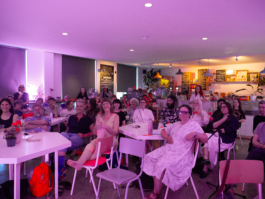
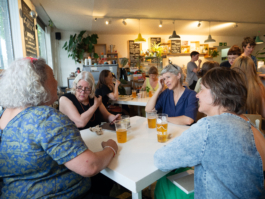
Writing Art Writing Art Writing symposium takes place in Spike Island’s Associates Space. The warm, blank noise of 100 electric fans necessarily accompanies the talks, discussions, performances: it is the last day of the latest heatwave. The weather both adds to and detracts from the day’s events. The body becomes more difficult than usual to ignore — it becomes a tangible presence and influence within acts of speaking and listening. The regulation of bodily temperature dictates the length of sessions and the arrangement of spaces. The standard order of things is disrupted by this attention to the body: the symposium reorients itself towards the more immediate, embodied conditions of its own unfolding.
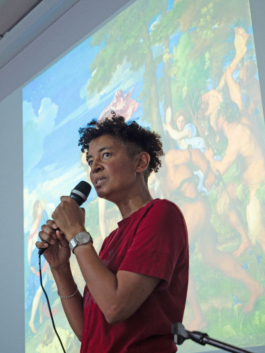
Katrina starts the day talking about the death notice mounted on the gates of Buckingham Palace on the day the Queen of England died. She shows a series of grainy stills from a recording of the scene, focusing on the curation of the announcement; the performance by the men in uniform chosen to install the sign; the carefully chosen phrasing and layout of the notice. The intricacies of the death notice, and its brief detailing of the succession of the King, are analysed like poetry — the fusion of an ending and a beginning; a pause and a death marked spatially by a line break, by an indent. Katrina goes on to discuss the time she spent with a Titian painting during her experience as artist in residence at the National Gallery. She describes the painting’s depiction of love at first sight; a moment that seems to have caused a supernatural, disruptive wave of sensation. Her attention shifts from the mechanics of desire within the image to her own uneasiness in her residency within this weighty institution, and finally to the fragility of the painting itself. She traces its history as a physical object, sold, transported and restored many times — a network of cracks in the painting’s surface tells of its once having been hastily rolled up. It even has a knife wound, a scar from a botched conservation attempt that almost destroyed it. Katrina’s focus on the points at which these texts and objects begin to fray — the points at which they are vulnerable, unsettled, or absurd — redirects attention from an appearance of authority towards the power relations that produce and sustain that sense of authority. What first appears natural or inevitable instead emerges as contingent and carefully maintained, and therefore open to question, even destabilisation
In the break there is a chance to look around the accompanying exhibition When Language Becomes Material, ahead of a Q&A session with the artists featured: Huma Mulji and Emmanuelle Waeckerlé, Young In Hong and Owen Lloyd, Jo Lathwood and Marianne Mulvey, Mary Hurrell, and Amak Mahmoodian. The exhibition considers the varied roles that writing can assume alongside and inside visual and sonic art practice. In part, the works explore the poetics of script — nuances of handwriting and type, or words formed through texture or absence. Surfaces are embossed or recessed to leave haptic inscriptions; elsewhere, letterforms appear as silhouettes against whatever it is that they are not, created through the painting of their absence. There are brief, bold phrases alongside expansive texts whose length quietly acknowledges that they will only ever be encountered in part, in fragments. There are works concerned with linguistic belonging and exclusion in matters of state legibility, as well as works that gesture towards the non-human languages spoken by animals and machines. A large, slow-shutter image of a hand in motion stands in the middle of the space, foregrounding the body’s own expressive language. When Language Becomes Material takes place in Spike Island’s ‘The Corridor’: an exhibition space that is also a functioning corridor between studio spaces. An appropriately transitional space, then, to house these works that embrace an often ‘placeless writing, writing that can’t settle anywhere, writing that hovers over or below a visual art practice’ (Mira Dayal, 2025)
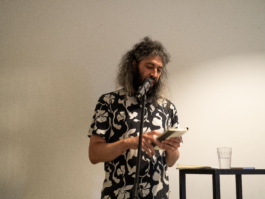
Pretend that you’re Rome: dead and alive, alive and dead. A zenith of ancient imperial power is insulted again and again, and nobody is offended. Everybody is insulted, and everybody is delighted. The first of three performances is introduced to the audience via Sam’s appeal to open-mindedness: please listen with generousness, curiousness, forgivingness-ness, patience. A reminder that there is more than one way to pay attention, and then a winding, wandering text, tense and aching with the sideways intimacy of insults. Insults, and/or a mischievous lens through which to observe and think about the grossness and beauty of a city at night, a contemporary, ancient place. Pale museums and curves of marble and apartment blocks, washing lines and cigarette ashes on a saucer on a windowsill. This is just the surface of it. You have to find a way to get past the surface
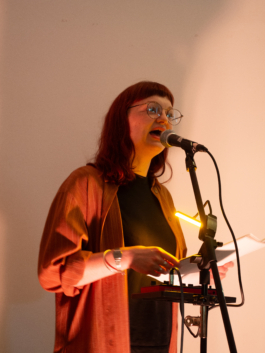
Lydia slowly describes a scene, romantic and unsettling. The night falls behind the curtain. She describes the music playing as two people’s hands meet across the table. Shifting register by starting to sing, her voice becomes the music in the bar. Lydia becomes the singer in this strange bar; strangely out of place and time. Her improvisory scatting — which, like humming or whistling, is voicing, but not saying — tells us something about feeling by choosing to remain non-specific. As narrator becomes singer, the voice shifts between diegeses. The singer doesn’t have the same privileges as the all-knowing narrator, but — as the bar from the text begins to resemble or become the room that we’re sitting in, in chairs around tables, listening to a singer — she occupies both spaces at once, present in and presenting the text, a voice connecting separate selves and atmospheres
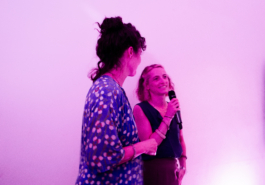
Pink lights have made the room pink. Anna reads to us while the same words are projected onto the wall: a chunk of white sans serif text without commas or full stops establishes a connection between her voice and the reader’s subvocal voice, the voice inside the head, a long and muddy stream of consciousness. Her text — a flow of repetitions, wordplay, and misheard phrases — foregrounds the more personal, immediate ways in which reading is both an imaginative and piecemeal process. Reading, itself an act of re-authoring, internalises and interrupts the physical text, exceeding the sense of order that lines of typography suggest. A word or phrase is read again and again, until it sticks and can be left behind. Anna misspells and mispronounces the names of several people who are famous for being clever: she holds space for internal processes of mucking about that are inherent to the experience of both writing and reading — distracted forms of play brought to the fore by physical, emotional, textual fatigue
The noise of the fans will blanket every audio recording I take on my phone: a hovering noise loud enough to press on the shapes of the various performers’ words. I listen back at full-volume and still I can’t always understand. The materiality of language — already made palpable by the skilful texts, artworks, performance, and careful curation referenced above — is amplified after the fact through occasional, murky breaks with semantic intelligibility imposed by background noise and a low-resolution mp3 format. After the fact, in the context of the weather and the end of the world, a fantastical gap is bridged non-discursively, by the muffled cadence of the voices of performers, by audience laughter and applause, by the sound of a pint glass wet with condensation, carefully returned to the tabletop


All photography courtesy of Emmett Lloyd

Part of the ongoing Writing Art Writing Art Writing learning programme — a collaboration between WITTA and Spike Island — this workshop, led by Professor Sarah Hayden is for artists, writers and everyone who is (or intends to be) part one and a bit of the other. Together, we’ll take on description and / in its paradoxical relation to art writing.

An afternoon exploring the intersections between art and writing with keynote presentation from artist-writer Katrina Palmer, and an in-conversation with Huma Mulji and Emmanuelle Waeckerlé, Jo Lathwood and Marianne Mulvey, and Mary Hurrell, chaired by Lizzie Lloyd. It was followed by an evening salon of dinner accompanied by performances by Anna Barham, Lydia Davies and Sam Hasler.
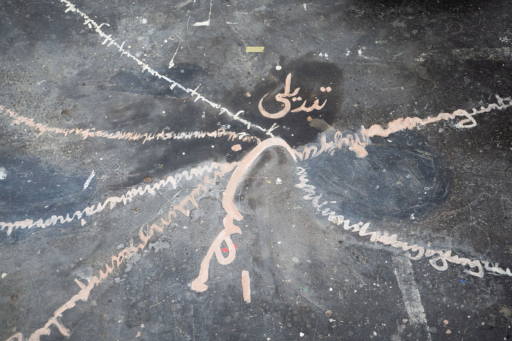
When Language Becomes Material explores the material possibilities, traces and manifestations of language in art. The exhibition includes work by Huma Mulji and Emmanuelle Waeckerlé, Young In Hong and Owen Lloyd, Jo Lathwood and Marianne Mulvey, Mary Hurrell, and Amak Mahmoodian.
Sign-up here to subscribe to our mailing list, to receive updates, forthcoming WITTA events, reading lists and new writing from our WITTA network.

WAWAW will involve an afternoon exploring the intersections between art and writing with keynote presentations from artist-writers Katrina Palmer and Roy Claire Potter, followed by an evening salon of dinner accompanied by performances by Anna Barham, Lydia Davies and Sam Hasler.

A new project supported by WITTA to explore experimental ways of making texts and images. The project is devised by Potato Press, formed of Lesley Guy, Kate Liston and Tom O’Sullivan and with contributions from Sarah Jackson and Leah Millar.

WITTAnights are a place for showing, reading, listening and trying things out.

Calling all artists who write, writers who art(!) and everything in between: tell us more about your work.

The WITTA podcast — hosted by Lizzie Lloyd and Kit Poulson — invites guests to reflect on why they do things with words, how they do things with words and what words allow them to do that other materials don’t.

Through various WITTA events, working with participants and collaborators within and beyond the university, questions have emerged.

This WITTAfilm was made from interviews and materials gathered at an informal week-long creative residency / experiment called WITTAverse.

In July 2023, WITTAverse happened. It was a week-long event which involved a range of artists, writers, composers, and students.

Members of the Ways of Writing in Art & Design (WoW) network, which is housed within the Visual Culture Research Group, have written and guest edited the first of two special issues of the Journal of Writing in Creative Practice.
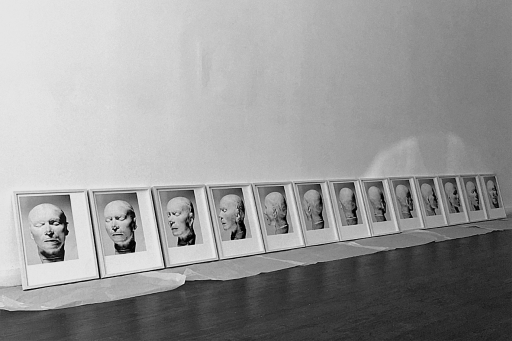
Invitation to work as part of a research group devised by artists Beverley Carruthers and Wiebke Leister, which investigates contemporary modes of collaborative image-text-production.

Freya Dooley and Cinzia Mutigli’s ongoing collaboration spans writing, performance, sound and moving image.
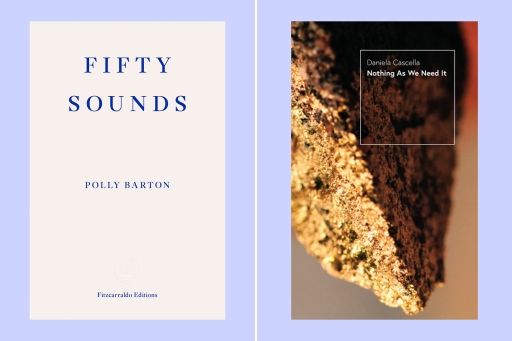
In this inaugural event we invite Polly Barton and Daniela Cascella to discuss translation, relationships between art, writing and sound, and what it means to write between disciplines.

This evening of conversation with artist Katy Beinart, writer Lizzie Lloyd and curator Marianne Mulvey will consider their shared interests in socially engaged or participatory art projects.
WITTA (Writing In / To / Through Art) is the start of what I hope to become a fully fledged research group at UWE Bristol.

Writing Art Writing Art Writing symposium takes place in Spike Island’s Associates Space. The warm, blank noise of 100 electric fans necessarily accompanies the talks, discussions, performances: it is the last day of the latest heatwave. The weather both adds to and detracts from the day’s events. The body becomes more difficult than usual to ignore — it becomes a tangible presence and influence within acts of speaking and listening. The regulation of bodily temperature dictates the length of sessions and the arrangement of spaces. The standard order of things is disrupted by this attention to the body: the symposium reorients itself towards the more immediate, embodied conditions of its own unfolding.
Katrina starts the day talking about the death notice mounted on the gates of Buckingham Palace on the day the Queen of England died. She shows a series of grainy stills from a recording of the scene, focusing on the curation of the announcement; the performance by the men in uniform chosen to install the sign; the carefully chosen phrasing and layout of the notice. The intricacies of the death notice, and its brief detailing of the succession of the King, are analysed like poetry — the fusion of an ending and a beginning; a pause and a death marked spatially by a line break, by an indent. Katrina goes on to discuss the time she spent with a Titian painting during her experience as artist in residence at the National Gallery. She describes the painting’s depiction of love at first sight; a moment that seems to have caused a supernatural, disruptive wave of sensation. Her attention shifts from the mechanics of desire within the image to her own uneasiness in her residency within this weighty institution, and finally to the fragility of the painting itself. She traces its history as a physical object, sold, transported and restored many times — a network of cracks in the painting’s surface tells of its once having been hastily rolled up. It even has a knife wound, a scar from a botched conservation attempt that almost destroyed it. Katrina’s focus on the points at which these texts and objects begin to fray — the points at which they are vulnerable, unsettled, or absurd — redirects attention from an appearance of authority towards the power relations that produce and sustain that sense of authority. What first appears natural or inevitable instead emerges as contingent and carefully maintained, and therefore open to question, even destabilisation
In the break there is a chance to look around the accompanying exhibition When Language Becomes Material, ahead of a Q&A session with the artists featured: Huma Mulji and Emmanuelle Waeckerlé, Young In Hong and Owen Lloyd, Jo Lathwood and Marianne Mulvey, Mary Hurrell, and Amak Mahmoodian. The exhibition considers the varied roles that writing can assume alongside and inside visual and sonic art practice. In part, the works explore the poetics of script — nuances of handwriting and type, or words formed through texture or absence. Surfaces are embossed or recessed to leave haptic inscriptions; elsewhere, letterforms appear as silhouettes against whatever it is that they are not, created through the painting of their absence. There are brief, bold phrases alongside expansive texts whose length quietly acknowledges that they will only ever be encountered in part, in fragments. There are works concerned with linguistic belonging and exclusion in matters of state legibility, as well as works that gesture towards the non-human languages spoken by animals and machines. A large, slow-shutter image of a hand in motion stands in the middle of the space, foregrounding the body’s own expressive language. When Language Becomes Material takes place in Spike Island’s ‘The Corridor’: an exhibition space that is also a functioning corridor between studio spaces. An appropriately transitional space, then, to house these works that embrace an often ‘placeless writing, writing that can’t settle anywhere, writing that hovers over or below a visual art practice’ (Mira Dayal, 2025)
Pretend that you’re Rome: dead and alive, alive and dead. A zenith of ancient imperial power is insulted again and again, and nobody is offended. Everybody is insulted, and everybody is delighted. The first of three performances is introduced to the audience via Sam’s appeal to open-mindedness: please listen with generousness, curiousness, forgivingness-ness, patience. A reminder that there is more than one way to pay attention, and then a winding, wandering text, tense and aching with the sideways intimacy of insults. Insults, and/or a mischievous lens through which to observe and think about the grossness and beauty of a city at night, a contemporary, ancient place. Pale museums and curves of marble and apartment blocks, washing lines and cigarette ashes on a saucer on a windowsill. This is just the surface of it. You have to find a way to get past the surface
Lydia slowly describes a scene, romantic and unsettling. The night falls behind the curtain. She describes the music playing as two people’s hands meet across the table. Shifting register by starting to sing, her voice becomes the music in the bar. Lydia becomes the singer in this strange bar; strangely out of place and time. Her improvisory scatting — which, like humming or whistling, is voicing, but not saying — tells us something about feeling by choosing to remain non-specific. As narrator becomes singer, the voice shifts between diegeses. The singer doesn’t have the same privileges as the all-knowing narrator, but — as the bar from the text begins to resemble or become the room that we’re sitting in, in chairs around tables, listening to a singer — she occupies both spaces at once, present in and presenting the text, a voice connecting separate selves and atmospheres
Pink lights have made the room pink. Anna reads to us while the same words are projected onto the wall: a chunk of white sans serif text without commas or full stops establishes a connection between her voice and the reader’s subvocal voice, the voice inside the head, a long and muddy stream of consciousness. Her text — a flow of repetitions, wordplay, and misheard phrases — foregrounds the more personal, immediate ways in which reading is both an imaginative and piecemeal process. Reading, itself an act of re-authoring, internalises and interrupts the physical text, exceeding the sense of order that lines of typography suggest. A word or phrase is read again and again, until it sticks and can be left behind. Anna misspells and mispronounces the names of several people who are famous for being clever: she holds space for internal processes of mucking about that are inherent to the experience of both writing and reading — distracted forms of play brought to the fore by physical, emotional, textual fatigue
The noise of the fans will blanket every audio recording I take on my phone: a hovering noise loud enough to press on the shapes of the various performers’ words. I listen back at full-volume and still I can’t always understand. The materiality of language — already made palpable by the skilful texts, artworks, performance, and careful curation referenced above — is amplified after the fact through occasional, murky breaks with semantic intelligibility imposed by background noise and a low-resolution mp3 format. After the fact, in the context of the weather and the end of the world, a fantastical gap is bridged non-discursively, by the muffled cadence of the voices of performers, by audience laughter and applause, by the sound of a pint glass wet with condensation, carefully returned to the tabletop


Part of the ongoing Writing Art Writing Art Writing learning programme — a collaboration between WITTA and Spike Island — this workshop, led by Professor Sarah Hayden is for artists, writers and everyone who is (or intends to be) part one and a bit of the other. Together, we’ll take on description and / in its paradoxical relation to art writing.

An afternoon exploring the intersections between art and writing with keynote presentation from artist-writer Katrina Palmer, and an in-conversation with Huma Mulji and Emmanuelle Waeckerlé, Jo Lathwood and Marianne Mulvey, and Mary Hurrell, chaired by Lizzie Lloyd. It was followed by an evening salon of dinner accompanied by performances by Anna Barham, Lydia Davies and Sam Hasler.

When Language Becomes Material explores the material possibilities, traces and manifestations of language in art. The exhibition includes work by Huma Mulji and Emmanuelle Waeckerlé, Young In Hong and Owen Lloyd, Jo Lathwood and Marianne Mulvey, Mary Hurrell, and Amak Mahmoodian.

Sign-up here to subscribe to our mailing list, to receive updates, forthcoming WITTA events, reading lists and new writing from our WITTA network.

WAWAW will involve an afternoon exploring the intersections between art and writing with keynote presentations from artist-writers Katrina Palmer and Roy Claire Potter, followed by an evening salon of dinner accompanied by performances by Anna Barham, Lydia Davies and Sam Hasler.

A new project supported by WITTA to explore experimental ways of making texts and images. The project is devised by Potato Press, formed of Lesley Guy, Kate Liston and Tom O’Sullivan and with contributions from Sarah Jackson and Leah Millar.

WITTAnights are a place for showing, reading, listening and trying things out.

Calling all artists who write, writers who art(!) and everything in between: tell us more about your work.

The WITTA podcast — hosted by Lizzie Lloyd and Kit Poulson — invites guests to reflect on why they do things with words, how they do things with words and what words allow them to do that other materials don’t.

Through various WITTA events, working with participants and collaborators within and beyond the university, questions have emerged.

This WITTAfilm was made from interviews and materials gathered at an informal week-long creative residency / experiment called WITTAverse.

In July 2023, WITTAverse happened. It was a week-long event which involved a range of artists, writers, composers, and students.

Members of the Ways of Writing in Art & Design (WoW) network, which is housed within the Visual Culture Research Group, have written and guest edited the first of two special issues of the Journal of Writing in Creative Practice.

Invitation to work as part of a research group devised by artists Beverley Carruthers and Wiebke Leister, which investigates contemporary modes of collaborative image-text-production.

Freya Dooley and Cinzia Mutigli’s ongoing collaboration spans writing, performance, sound and moving image.

In this inaugural event we invite Polly Barton and Daniela Cascella to discuss translation, relationships between art, writing and sound, and what it means to write between disciplines.

This evening of conversation with artist Katy Beinart, writer Lizzie Lloyd and curator Marianne Mulvey will consider their shared interests in socially engaged or participatory art projects.
WITTA (Writing In / To / Through Art) is the start of what I hope to become a fully fledged research group at UWE Bristol.